

Many of you ask us about PCQI training: Do you need it? What is it? Where can you register? How much does it cost? Does it expire?
At Sirocco Consulting Inc., we have been offering the PCQI course since 2018. Karine Lawrence, who holds a Master’s degree in Food Science and has 25 years of industry experience, has delivered numerous PCQI courses both on-site and remotely, through certification bodies and under the Sirocco Consulting Inc. brand.
We issue the PCQI certificate to registered participants who attend the course and actively participate. We offer both the full-length course and the hybrid course. The full-length course runs for three days, while Part 2 of the hybrid course is nine hours, excluding breaks. Read on to learn more about the PCQI training V2.0.

Understanding PCQI Training Version 2.0
The FSPCA Preventive Controls for Human Food Version 2.0 training is the only US FDA-recognized standardized curriculum designed to help food industry personnel meet the requirements for becoming a Preventive Controls Qualified Individual (PCQI) under the Food Safety Modernization Act (FSMA) and regulations. The course is offered by the Food Safety Preventive Control Alliance (FSPCA) and teaches participants how to develop and apply a Food Safety Plan under the Preventive Controls for Human Food rule, including current Good Manufacturing Practices, hazard analysis, process controls, allergen controls, sanitation controls, supply-chain controls, verification, validation, recall planning, and recordkeeping. Version 2.0 updates the earlier curriculum released in 2016 by incorporating newer FDA guidance, strengthening the connection between HACCP and preventive controls, updating hazard-analysis content with FDA’s PCHF guidance (specifically the hazard database under Appendix 1), common food safety hazards and adding updated allergen information such as sesame and coconut. Completion of the course is one way to satisfy the training expectations for a PCQI.

Who Needs PCQI Training Version 2.0?
The FSPCA Preventive Controls for Human Food Version 2.0 training is mainly for people who are responsible for preparing, overseeing, implementing, or maintaining a facility’s Food Safety Plan under the PCHF rule. The FSMA Preventive Controls for Human Food (PCHF) rule applies to domestic and foreign facilities that manufacture, process, pack, or hold human food for consumption in the United States, unless an exemption or modified requirement applies. In general, the rule applies to facilities that are required to register with the US FDA under section 415 of the Federal Food, Drug, and Cosmetic Act, which was added by the Public Health Security and Bioterrorism Preparedness and Response Act of 2002. These facilities must develop and implement a written Food Safety Plan that includes hazard analysis and risk-based preventive controls, as appropriate to the facility and its products.
The person with authority under the PCHF rule is the Preventive Controls Qualified Individual (PCQI). PCQIs can be food safety and quality assurance managers, HACCP or food safety team members, operations managers, sanitation leads, production supervisors, regulatory/compliance staff, and sometimes upper management at food manufacturing, processing, packing, or holding facilities. FSPCA describes the intended audience as those responsible for performing or overseeing preparation of the food safety plan, and university/industry providers also note it is useful for staff in areas where preventive controls are applied, such as Quality assurance, Sanitation, Operations, Logistics, Maintenance, Procurement and Management.
Does PCQI Training Replace HACCP?
No. FSPCA Preventive Controls for Human Food Version 2.0 does not replace HACCP; it builds on HACCP concepts and connects them to the U.S. FSMA preventive controls requirements. HACCP is an international standard and traditionally focuses on identifying food safety hazards and controlling them at critical control points, while preventive controls go broader by also covering things like allergen preventive controls, sanitation preventive controls, supply-chain preventive controls and recall planning. Version 2.0 was specifically updated to improve the linkage between HACCP and preventive controls, so facilities that already use HACCP can often adapt parts of their HACCP system into a FSMA-compliant Food Safety Plan, but they still need to make sure all preventive-control requirements are addressed.
How to Register for PCQI Training Version 2.0
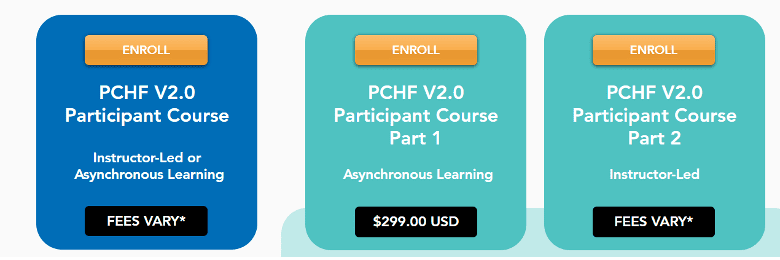
Register through the FSPCA course page under the “Enroll in a Course” tab. They list the Version 2.0 options: instructor-led, asynchronous/self-paced, or blended Part 1 + Part 2. Both parts are required if you choose the blended route. Note that full completion of Part 1 is required after attending Part 2 and before obtaining a PCQI certificate. You will need to review all slides in the FSPCA manual. A part 1 ticket will be issued which you can provide to your Part 2 instructor.
You can also register through approved training providers, such as Sirocco Consulting Inc. Fees and dates vary by provider. We charge a competitive group rate for the 3-day course and 350 USD (certificate cost is included) for the hybrid course (part 2). Feel free to contact us and check our testimonials on Google and on our website. Part 1 can be taken through FSPCA at a cost of 299 USD. Feel free to browse through the FSPCA course list to obtain prices based on your geographical area.
Does PCQI Certification Expire?
The FSPCA PCQI certificate generally does not expire under current FDA rules, but refresher training is often recommended every 5 years to stay current. Also, Version 1.2 was retired for new course deliveries in 2025, so anyone registering now should take Version 2.0.
If you think the PCQI course is for you, you may want to browse our ABCD of FSMA/PCHF and PCQI V2.0 for important acronyms, food safety and regulatory concepts.
ABCD of FSMA, PCHF and the PCQI course V2.0
A — Allergen Control
Allergen controls are a major part of the Food Safety Plan. Allergens are food safety hazards listed under chemical hazards. Controls may include sanitation of food contact services and allergen declaration on food labels.
B — Biological Hazard
A food safety hazard caused by microorganisms such as pathogenic bacteria, viruses, or parasites that result in illness if the food is consumed. Biological hazards are one of the hazard categories considered during the hazard analysis step under 21 CFR Part 117.
C — Corrective Action
Action taken when preventive controls are not properly implemented or when monitoring shows a deviation from food safety parameters and values. Corrective actions help correct the problem, reduce the chance of recurrence, and evaluate affected food for safety.
D — Defect Action Level
A level of natural or unavoidable defect in food that FDA may use to determine whether food is adulterated. This term is connected to cGMP expectations in human food manufacturing.
E — Environmental Monitoring
A verification activity used when contamination of a ready-to-eat food with an environmental pathogen is a hazard requiring a preventive control. It is especially important in facilities handling exposed ready-to-eat foods.
F — Food Safety Plan
A written plan required for covered facilities. It includes hazard analysis, preventive controls, supply-chain program when applicable, recall plan when applicable, monitoring procedures, corrective action procedures, verification procedures, and records. The written food safety plan requirement appears in Subpart C of 21 CFR Part 117.
G — GMP / cGMP
Current Good Manufacturing Practice (cGMP) requirements are the baseline sanitary and operational conditions for producing safe food. In 21 CFR Part 117, cGMP requirements appear mainly in Subpart B.
H — Hazard Analysis
The process of identifying and evaluating known or reasonably foreseeable hazards to determine whether any hazards require preventive controls. The FDA states that covered facilities must conduct a hazard analysis as part of the PCHF rule.
I — Implementation Records
Records showing that the Food Safety Plan is being followed. These may include monitoring records, corrective action records, verification records, validation documentation, calibration records, and supply-chain records.
J — Judgment of the PCQI
The PCQIs use scientific knowledge, training, experience, and facility-specific information to decide which hazards require preventive controls and what verification, validation, monitoring, and corrective actions are appropriate. They also verify records within 7 days and conduct plan re-assessment every 3 years unless process or product change and in the event of a food recall or plan failure.
K — Known or Reasonably Foreseeable Hazard
A biological, chemical, including radiological, or physical hazard that is known to be, or has the potential to be, associated with the facility or the food. This is a central concept in the hazard analysis process under the PCHF rule.
L — Labeling Control
A control used to ensure food labels are accurate, especially for allergens. Mislabeling can create a serious food safety risk if allergens are missing from the label.
M — Monitoring
The routine observation or measurement used to assess whether a preventive control is operating as intended. Monitoring must be documented when required by the Food Safety Plan.
N — Nonconformance
A failure to meet a food safety requirement, preventive control parameter, procedure, or regulatory expectation. Nonconformances may require corrective action and documentation.
O — Oversight
PCQI oversight includes preparing or overseeing the Food Safety Plan, validating preventive controls, reviewing records, reviewing corrective actions, and reanalyzing the plan when required.
P — Preventive Controls
Risk-based procedures, practices, and processes used to significantly minimize or prevent hazards. Preventive controls may include process controls, allergen controls, sanitation controls, supply-chain controls, and a recall plan when a hazard requiring a preventive control is identified.
Q — Qualified Individual
A person who has the education, training, or experience necessary to manufacture, process, pack, or hold clean and safe food as appropriate to their assigned duties. QIs may review FSVPs. This is different from a PCQI, although a PCQI is also a type of qualified individual. PCQIs develop plans and validate process preventive controls.
R — Recall Plan
A written plan required when a hazard requiring a preventive control has been identified. It describes how the facility will notify consignees, notify the public when appropriate, conduct effectiveness checks, and dispose of affected food.
S — Supply-Chain Control
A preventive control used when a hazard in a raw material or ingredient is controlled before receipt by the facility. This can involve approved suppliers, supplier verification, audits, testing, records, and other verification activities.
S- SAHCODHA stands for Serious Adverse Health Consequences or Death to Humans or Animals. In FSMA/PCQI language, a SAHCODHA hazard is a food safety hazard that could cause very serious illness, injury, or death if not controlled. It is especially important in hazard analysis, supply-chain controls, and foreign supplier verification, because higher-risk hazards may require stronger verification activities, such as more rigorous supplier approval, audits, testing, review of records, or other documented controls.
T — Training
Training is required so individuals can perform their assigned food safety duties. PCQI training, such as the FSPCA standardized curriculum, is one way to help an individual qualify to develop and oversee a FSMA-compliant Food Safety Plan.
U — Unqualified Facility Exemption / Qualified Facility Status
Some very small businesses may be subject to modified requirements instead of the full preventive controls requirements. 21 CFR Part 117 includes modified requirements and provisions related to qualified facility exemptions.
V — Validation
Obtaining and evaluating scientific and technical evidence that a preventive control, when properly implemented, can effectively control the identified hazard. Validation is required for certain preventive controls unless an exception applies.
W — Written Procedures
Procedures included in the Food Safety Plan that explain how monitoring, corrective actions, verification, validation, sanitation, allergen control, supply-chain control, or recall activities will be performed and documented.
X — X-ray
X-ray inspection can be a process preventive control under the FSMA PCHF rule when it is used to significantly minimize or prevent a physical hazard, such as metal, glass, stone, bone, dense plastic, or other detectable foreign material in food.
Y — Yield / Traceability
Under FSMA, traceability is covered mainly by the Food Traceability Rule, also called FSMA Section 204. It is separate from the PCHF rule, but it connects to PCQI work because traceability records support recalls, supplier controls, corrective actions, and food safety investigations. The rule requires certain businesses that manufacture, process, pack, or hold foods on the Food Traceability List (FTL) to keep additional traceability records. These records are built around Critical Tracking Events (CTEs) and Key Data Elements (KDEs). In simple terms, companies must be able to show where a food came from, what happened to it, where it went, and which lot was involved. FDA says the purpose is to allow faster identification and removal of potentially contaminated food from the market.
Z — Zoning (sanitation preventive controls)
A sanitation and environmental monitoring concept that divides areas based on proximity to food contact surfaces. Zone-based thinking helps facilities manage environmental pathogen risks, especially in ready-to-eat food operations.
Sirocco Food & Wine Consulting has supported the food industry in Canada and the United States since 2014 offering food safety, regulatory, sensory evaluation training and consulting services. Sign up for our newsletter to keep up-to-date with industry and regulatory changes.


